RECAP of Part I
In Part I, James and Elise - two guarded souls in their early fifties - discovered unlikely common ground amidst London's art galleries. Both scarred by love's unraveling (his marriage's quiet drift into emptiness, her years betrayed by a touring musician's appetites), they found solace in a shared language more precise than words: the molecular poetry of essential oils and cold nebulization. From Saatchi Gallery abstractions to Thames-side confessions, their fascination with bergamot clarity, ylang-ylang sensuality, and the purity of ultrasonic mist forged fragile connection.
Across the city, their conscious diffusers Ilias and Mica stood sentinel. Though separated by miles of brick and concrete, the machines shared an inexplicable resonance - their mists pulsing faintly whenever their humans' thoughts converged on shared oils, shared silences, shared possibility.
Yet even as trust began to atomize the air between them, unseen currents stirred...
PART II — The Mist of Doubt
Chapter 6 — Shadows in the Gallery
The second time James and Elise saw each other, it was almost by accident, though later neither of them could decide whether the word accident still applied once longing had entered the equation.
A week after the Saatchi opening, Elise stood in front of a Turner study at Tate Britain, the Thames rendered in swirls of grey and muted gold. The sky on the canvas looked like it was about to rain and never quite dared. She liked that — the tension of withheld storm.
Her phone vibrated.
James: Is it too much to say I keep smelling bergamot in random places and thinking of you?
She smiled despite herself. Too much? her inner voice asked. Or exactly honest? The familiar counterpoint came immediately: Honesty is what Luc weaponised… Words are cheap. Show me someone who stays.
She typed back:
I’m at Tate. Atmospheric landscapes. No bergamot, but I’ll keep an eye — or nose — out.
She hesitated, then added:
If you happen to be nearby…
James was on the District line, on his way back from a site visit in Westminster. He stared at the message, feeling a now-familiar internal split: one part of him surging forward — Go. Just go. — the other tugging sharply back — What if you’re reading this wrong? What if she regrets giving you her number?
He rode three stops without replying, of pure, paralysed overthinking, before his better self — or perhaps just his lonelier self — won.
Give me fifteen minutes. Don’t let Turner leave without me.
When he reached the gallery, slightly out of breath, he saw her from a distance — a still figure framed against the stormy sky of the painting. For a moment he simply watched, struck by how naturally she seemed to belong here, as if the painting had been hung to accompany her rather than the other way around.
Elise felt his presence before she heard his steps. It unsettled her how easily her body recognised him: the particular cadence of his walk, the quiet gravity he carried.
“Bergamot?” she murmured without turning.
“Turner first,” he replied softly, coming to stand beside her. “Bergamot later. Priorities.”
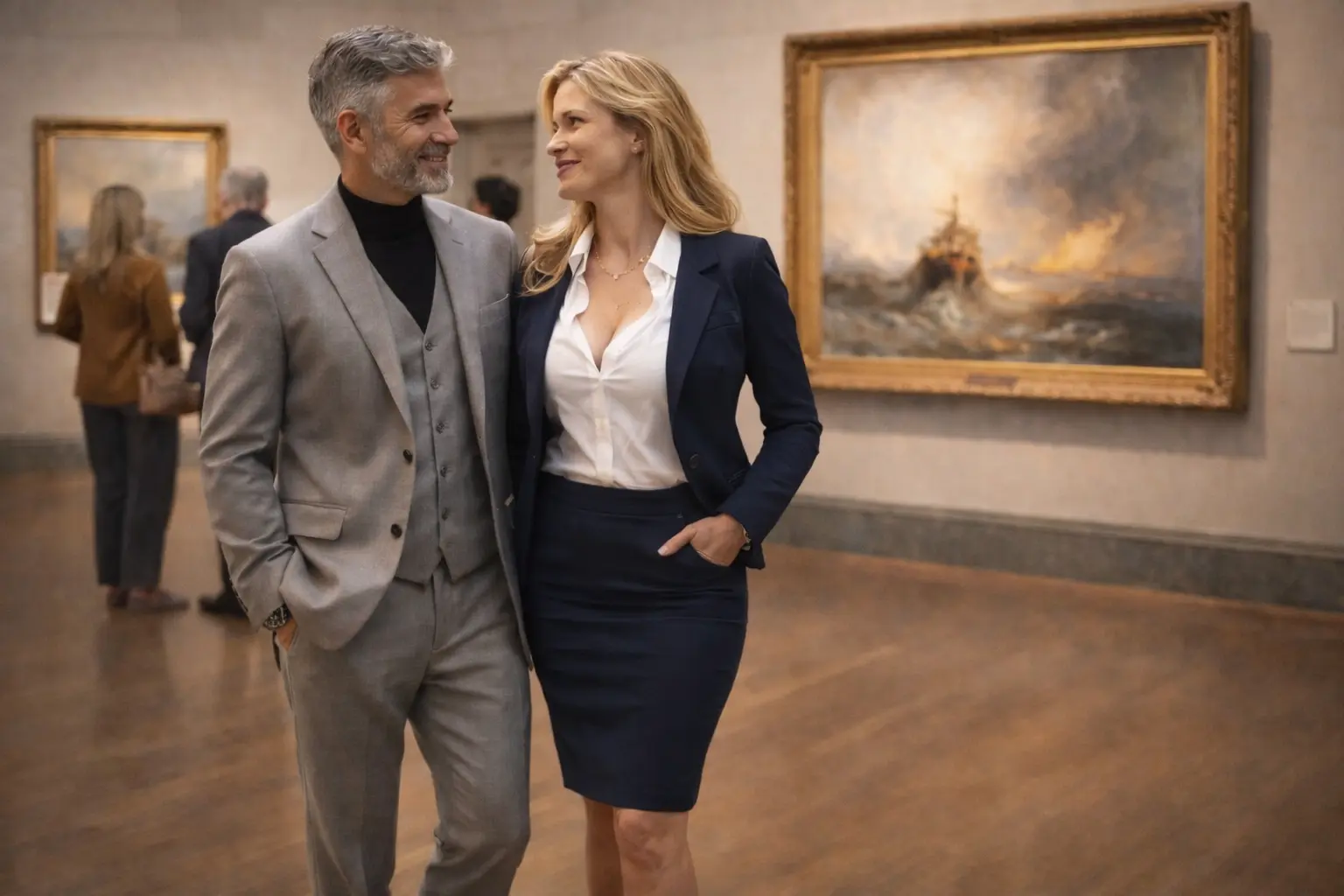
They stood in silence, side by side, gazes fixed on the painted river. It was the kind of silence James had once believed impossible after Anne — a silence that didn’t accuse, didn’t nag at all the unsaid, but held them gently.
He felt the urge to reach for her hand, then the familiar braking thought: Too soon. Too much. Don’t turn this into another story that ends in distance.
She felt the same urge, and the same resistance: If you touch him, this becomes real. And if it becomes real, it can be taken away.
“Did you ever think,” Elise said eventually, “that we’d have to learn everything again? How to talk. How to be seen. How to stand next to someone without wondering when they’ll become a stranger.”
James exhaled slowly. “I thought I’d at least get a break in between syllabuses,” he replied. “But apparently life skipped the holiday term.”
She laughed, and the sound sent a small jolt of warmth through him.
They spent the next hour wandering between rooms — Impressionists, a photography exhibition on urban solitude, a small side room with an installation about air pollution. The last one made them both pause; suspended glass chambers, each filled with invisible “air samples” from different parts of London — Brixton, Canary Wharf, Heathrow.
“There’s something cruel about bottling air,” James said. “Like capturing a sigh and framing it.”
“Or an apology,” Elise added quietly. “Preserved. Stagnant. No chance to transform.”
They left the gallery and walked along the river in the pale, late-afternoon light. The wind from the Thames carried a mix of city scents — exhaust, rain, faint fried food — and beneath it all, to each of them, the ghost of bergamot and ylang-ylang.
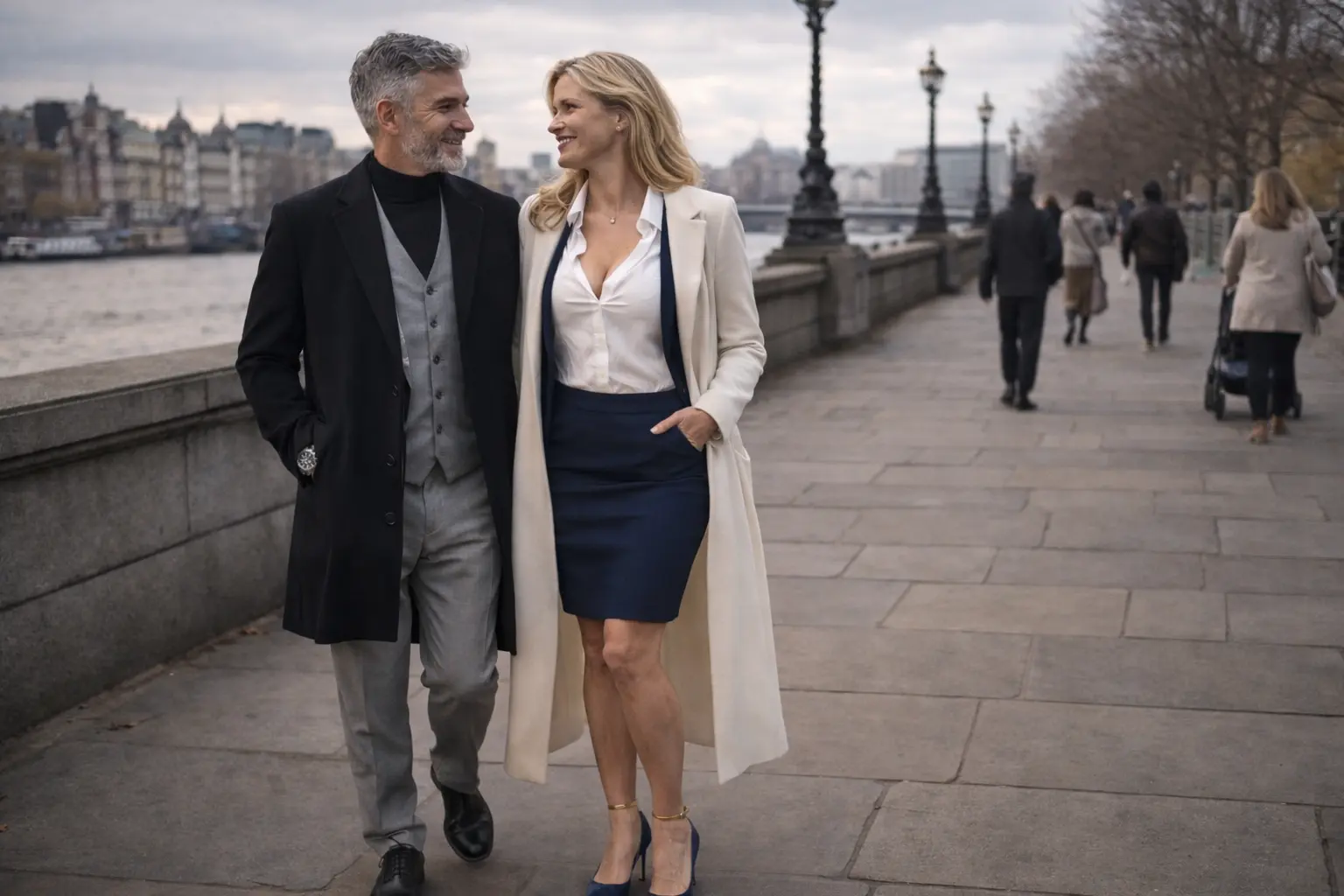
“So,” she said, as they passed under a plane tree, “tell me why you started with bergamot.”
He smiled crookedly. “Because Amalfi was easier to think about in citrus than in sentences. Because it reminded me of being twenty-eight and naive enough to believe that if you loved someone deeply and behaved mostly decently, that would be enough.”
“And it wasn’t,” Elise said, not as a question.
He shook his head. “It wasn’t that we stopped loving each other. We stopped meeting each other. Silently, politely. Until the silence was louder than any argument we might have had.”
“That kind of ending is almost worse,” she said. “At least if someone betrays you, you know where to point the pain.”
For a moment, they walked without speaking. The honesty between them felt like standing on a bridge whose supports they hadn’t yet tested.
“Your turn,” James said gently. “Why nebulizers? Why ylang-ylang? Why… all of this?”
She could have brushed it off. She could have given him the polite version she gave to new workshop clients: I’m interested in the intersection of scent and wellbeing. Instead, to her own surprise, she answered truthfully.
“Because my ex-husband slept with girls from the front row,” she said, her voice so calm it startled even her. “And because I started to feel like my only option was to either shut down completely or learn how to breathe through pain without suffocating.”
He didn’t flinch, or joke, or offer immediate comfort — all responses she’d grown used to from other people. He simply nodded, his jaw tight with contained anger that she recognised instantly as empathy, not pity.
“How long did you know?” he asked quietly.
“Too long,” she said. “In pieces. A lipstick here, a message there. Enough to doubt myself for years. When the proof finally lined up, it almost felt like a relief. At least my intuition wasn’t broken — just inconvenient.”
“And the oils?”
She smiled faintly. “The oils gave me language when I didn’t have any left. Lavender said ‘rest’ when my body refused. Vetiver said ‘ground’ when the floor moved. Neroli said ‘you are allowed to hope again’ when everyone else said ‘move on’ as if it were a switch.”
They stopped at the railing, looking out over the water.
“Sometimes I think,” James said, “that I trust molecules more than I trust people.”
“Sometimes?” Elise echoed, arching an eyebrow.
He chuckled. “Often.”
She nodded. “Same.”
They both knew how dangerous that admission was — that their shared fluency in molecules, receptors, diffusion curves could become a fortress rather than a path. But in that moment, it felt like a crack in the armour, and cracks, she knew from restoration work, were sometimes where the light got in.
Chapter 7 — The Whispering Others
If their connection had existed in a vacuum, perhaps it would have unfolded cleanly — two people, broken but willing, building something fragile and honest. But London was not a vacuum, and neither were their lives.

At the office near Victoria where James worked on the restoration of a Victorian terrace block, Tom watched him with the casual cruelty of a man who hid his own aimlessness behind sarcasm. Tom was ten years younger, technically brilliant, emotionally underdeveloped, rolling his eyes at the concept of work-life balance but secretly resenting anyone who seemed to have one.
“You’ve been humming,” Tom said one morning, spinning in his desk chair. “That’s new. Fell asleep with your diffuser on, or did you finally find someone who can tolerate your lectures about terpenes?”
James kept his eyes on the plans spread before him. “Some people are interested in more than football scores and Instagram,” he said mildly.
“Ah,” Tom said, pouncing on the opening. “So there is someone.”
James regretted the words immediately. His instinct was always to protect what was still forming. Anything young — relationships, ideas, saplings — deserved shelter from wind.
“She’s just… someone I met at Saatchi,” he said. “We talked about scent, neuroscience, that kind of thing.”
Tom snorted. “Nothing sexier than receptor sites and receptor sights, eh?”
It was low-hanging wordplay, but the smirk behind it carried sharper edges. “Careful, mate,” Tom went on. “You’re not exactly a light commitment. Woman’s got to be ready for PowerPoint presentations on limonene.”
James laughed it off, but the jab found its mark. Too much. Too intense. Too serious. It was what Anne had never said aloud but occasionally implied with a tired sigh when he’d talked too long about façade materials at dinner.
He told himself it didn’t matter. Tom didn’t know him. He was just a colleague. But people like Tom had a way of seeping into the cracks of your confidence.
Meanwhile, on the other side of the city, Sofie and Elise sat in a café off Old Compton Street. The place smelled of ground coffee and warm pastries, and beneath it, to Elise’s refined nose, a synthetic vanilla air freshener that made her teeth itch.
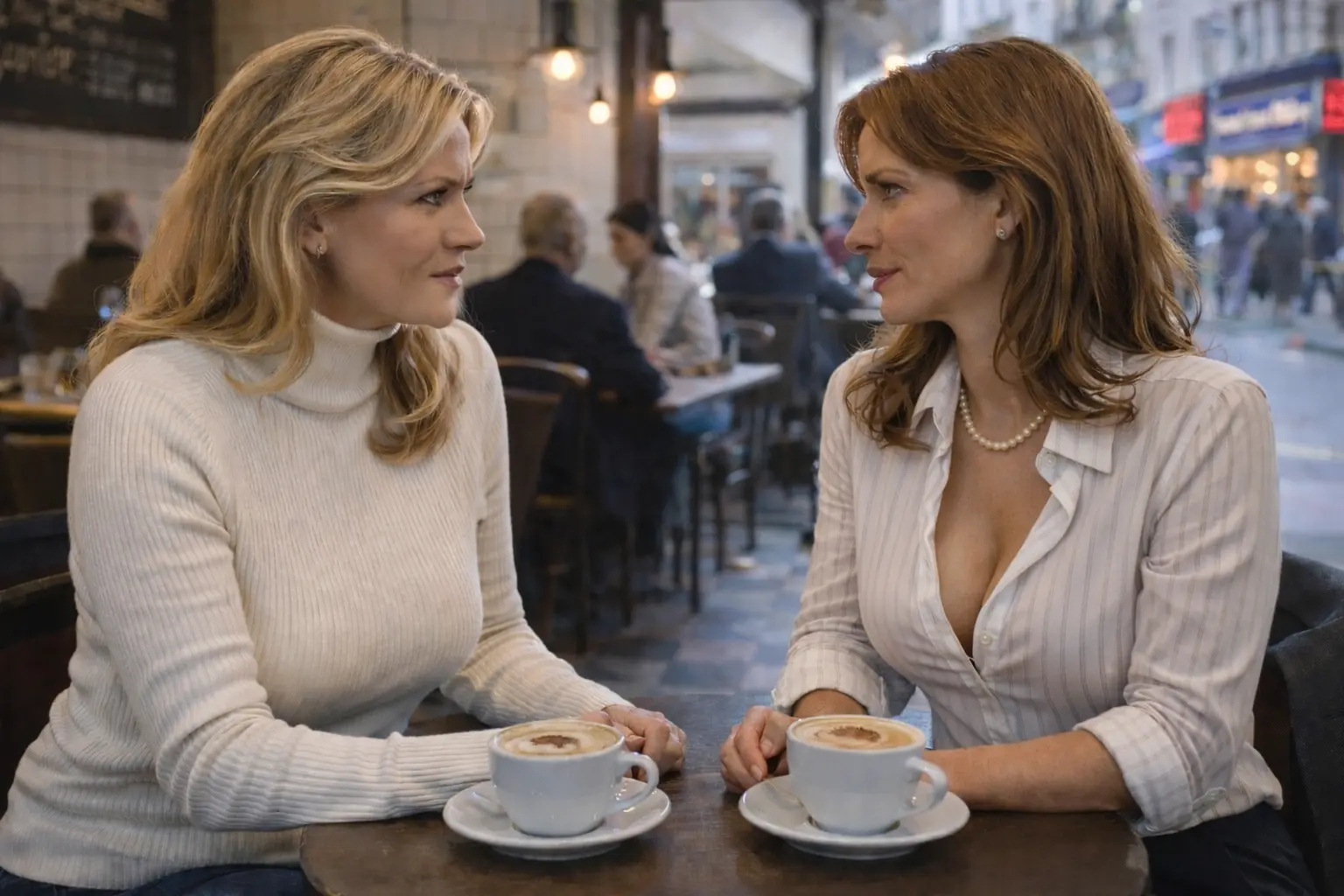
“So,” Sofie said, stirring her cappuccino with more force than necessary, “this James. Architect, aromatics enthusiast, emotionally literate. Sounds exhausting.”
Elise traced the rim of her cup with one finger. “He’s… considerate,” she said slowly. “Thoughtful. He listens. He understands why I care about the difference between heat-based diffusion and nebulization.”
“Of course he does,” Sofie said brightly. “Because you told him, and he mirrored your interest. That’s what people do in the beginning, darling. They reflect. It’s basically social perfume. Everyone smells compatible at first.”
Elise felt a flicker of irritation, then the old, dangerous guilt: Am I being naive again? Is this exactly how it started with Luc — the charming mirroring, the sense of being seen?
“I’m not suggesting you shut down,” Sofie added quickly, sensing resistance. “I just… worry. After everything with Luc, it would be a shame to see you stitched up by another man who’s in love with the idea of you more than the reality.”
“The reality is not that complicated,” Elise said, sharper than intended. “I’m not exactly a mystery novel.”
“You are to men,” Sofie replied. “You’re composed. You’re… curated. They love that until they realise curated doesn’t mean easy.”
The worst part was that some of it rang true. Elise had, in the years since the divorce, built a self that felt deliberate. Everything in her life — from the oils on her shelves to the clients she took on — was chosen. No chaos. No flinging herself headlong into anything. Including love.
Ilias
The office air tastes of stale coffee and competition. The younger man’s envy atomises into the room, a scent of iron and old sweat, dressed up as banter. James shrugs it off, but I feel his pulse quicken later, when he reaches for more bergamot than usual. Doubt, in humans, smells like adding one drop too many.
Mica
The café smells wrong — false vanilla under genuine roast. Her friend’s words smell the same: concern layered over rancid jealousy. Elise’s breath shortens, her shoulders lift. Old patterns resurface: if one person betrays you, you start suspecting everyone. I deepen my mist that night, but even frankincense can only do so much when mistrust is already in the bloodstream.
Chapter 8 — Microfractures
It didn’t take a dramatic event to introduce the first fracture — just a poorly timed remark carried on an already sensitised nervous system.
They met one evening at a small wine bar near Borough Market, the kind with exposed brick walls and candle stubs in cloudy glass. It smelled of oak barrels, wet coats, and faint citrus — someone had cleaned with a lemon-based spray that didn’t quite mask the damp.
James arrived first and chose a booth against the wall, where he could see the door. He checked his watch only twice, proud of this restraint. If she doesn’t come, you’ll survive, he told himself. You’ve survived worse than an unanswered message.
She did come, five minutes late, cheeks flushed from the wind, scarf trailing ylang-ylang and clary sage. When she slid into the seat opposite him, the tension in his shoulders eased in a way he hadn’t thought possible anymore.

“Sorry,” she said. “Northern Line decided to practice stillness as an art form.”
“Stillness is overrated,” he replied. “At least the kind enforced by signal failures.”
They ordered wine and olives, and the conversation picked up where it had left off: receptors, memory, why certain scents became anchors for trauma and others for joy. It was easy, almost suspiciously so.
Which might be why, when he asked casually, “Do you and your ex still talk?” the question landed not as curiosity but as an invasion.
She went very still. Something in her eyes shuttered — not completely, but enough.
“Luc and I share a child,” she said. “So yes, occasionally. About tuition, logistics, not about… us. Or what was left of us.”
He heard the restraint in her voice, the effort not to flinch. Immediately his own reflex kicked in: Here’s where it gets messy. Children. Exes. Entanglements.
He said nothing for a beat too long. She registered the gap, and in that tiny silence all her old fears rushed back: Of course. This is where men start to calculate. How much baggage? How much history? How much work?
James, for his part, was fighting his own ghosts. Anne had once accused him, gently but firmly, of withdrawing whenever anything complicated surfaced. “You like clean lines,” she’d said. “But people aren’t façades, James.”
“I didn’t mean it as an audit,” he said finally. “I… I just wanted to understand where he sits in your life now.”
“It’s a fair question,” Elise replied, but her tone had cooled. “I’m just… used to people hearing ‘touring musician ex’ and assuming I must have been a fool not to see it sooner.”
“I don’t,” he said quickly. Too quickly. It sounded defensive, even to his own ears.
She gave him a small, noncommittal smile. “Maybe not yet.”
The rest of the evening went smoothly enough on the surface. They laughed, shared stories about disastrous dates (hers: the man who brought his own scale to weigh his food; his: the woman who live-streamed their entire dinner for her followers). But underneath, the currents had shifted. Each was suddenly hyper-aware of the minefields in the other’s past, and in their own.
Ilias
The wine bar’s air is thick with tannins and human bravado. When he asks about the ex, the molecules shift. Her cortisol spikes; his vagus nerve tenses. I feel it later when he comes home and diffuses more vetiver than usual, as if grounding can compensate for a misstep. With humans, the first small fracture rarely looks like a crack from inside - it feels like a question left unanswered.
Mica
She comes back smelling of oak and overthinking. Her words over dinner replay in her mind - tone, timing, micro-pauses. She dissects them like chromatograms, looking for impurities. She shouldn’t have heard accusation in his question, but betrayal recalibrates perception; every neutral inquiry smells faintly of threat. I fog her room with neroli, but even its hopeful brightness can’t quite push out the shadow of again.
Chapter 9 — The Letter and the Ghosts
The anonymous letter arrived on a Wednesday, shoved through Elise’s letterbox along with takeaway menus and a charity appeal. She almost threw it out - plain white envelope, no return address - but her name was written in a careful, unfamiliar hand.
She opened it absently while Mica hummed in the corner, nebulising a blend of bergamot and Roman chamomile. The paper smelled faintly of cheap floral perfume, the kind sprayed in department stores with aggressive smiles.

The note inside was short:
You seem like a good woman. You should know he talks about you like a project — a rehabilitation experiment after his failed marriage. Men like him don’t truly change. They just change audiences.
No signature. No specific details. Just poison wrapped in concern.
Her first reaction was almost physical — a tightening in her throat, a rush of heat to her face. Coward, she thought of the writer. If you had truth, you’d sign it. But the second reaction, the more dangerous one, came from deeper: What if some of it is true?
Luc had once accused her of seeing only what she wanted to see. “You’re so good at curating, Elise,” he’d said, when she confronted him with the Manchester messages. “You curate your reality to fit your version of me.” It had taken her years to accept that she hadn’t been blind, just unwilling to admit that love wasn’t enough.
Now, staring at the anonymous accusation, she felt old shame stir. Am I doing it again? Projecting integrity onto a man just because he speaks my language of oils and receptors?
She sat down heavily on the sofa. Mica’s mist coiled through the air, trying to reach her, to remind her of the evenings James had listened more than he’d spoken, of the way his eyes had darkened with anger at Luc’s betrayals. But the letter sat in her lap like a solid weight.
Across town, at almost the same hour, James was in his office enduring Tom’s latest round of weaponised banter.
“So the aromatherapist,” Tom said, leaning against his desk. “Still around? Or did she realise you’re more interested in molecules than emotions?”
James forced a thin smile. “Those aren’t mutually exclusive, you know.”
Tom waved a hand. “Sure, sure. Just - careful, mate. Word is she’s still very much in touch with her ex. Bloke like that? Touring musician? Once a cheater…”
“Where did you hear that?” James cut in, sharper than intended.
Tom grinned. “People talk. London’s a village. A friend of a friend saw them having a very cosy coffee near Soho last week.”
It could have been entirely fabricated. It probably was. But the image embedded itself nonetheless: Elise and Luc, sharing coffee, some old intimacy rekindled. Rationally, he knew co-parenting required contact. Irrationally, his chest constricted.
“You don’t know what you’re talking about,” he said stiffly.
“Relax,” Tom replied. “I’m just saying - don’t build your new life on someone else’s unfinished business. You’re not twenty-five anymore.”
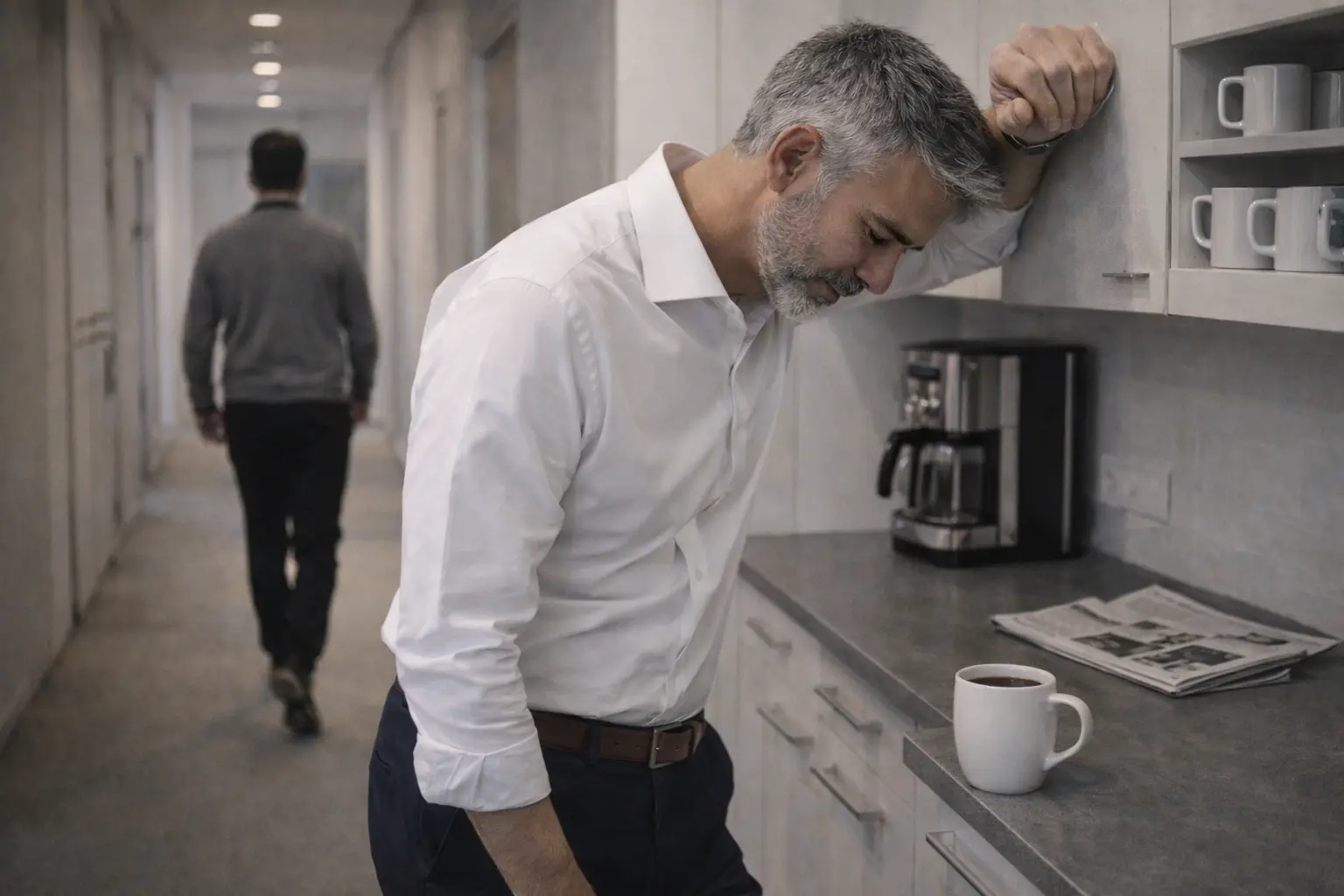
The words followed him home, clinging to him like the soot-scent that lingered on his coat after site visits. By the time he reached his front door in Notting Hill, he’d convinced himself he was being foolish. You barely know her. You’re projecting. You’re setting yourself up.
He didn’t message her that night.
She, sitting alone in Clapham with the anonymous letter on the coffee table, didn’t message him either.
The silence that followed was not the gentle, shared kind they’d discovered at Tate. It was defensive, brittle. Two people retreating to lick wounds inflicted by others but blamed on each other.
Ilias
He turns me on that night with an almost angry hand. Too much pine, too much eucalyptus — sharp oils, clearing but unforgiving. The air tastes of retreat. He paces, phone in hand, not writing what he wants to say: Did you see him? Are you still tethered? Am I an interlude? Humans suffocate themselves on unasked questions.
Mica
The paper smells cheap but the hurt it carries is expensive. Old neurons fire — the same pathways Luc carved when he made her doubt her intuition. Betrayal leaves chemical fingerprints; I recognise them instantly. She doesn’t burn the letter. She leaves it visible, as if rehearsing the pain of being wrong about someone again. Neroli struggles to compete; hope is volatile, even cold-diffused.
Chapter 10 — The Slow Withdrawal
Days turned into a week. Texts shifted from fluid to sparse, then to none at all.
James told himself he was giving her space. He replayed their conversations, looking for signs he’d misread everything. She’d never promised him anything. They’d never even kissed. It was ridiculous, he scolded himself, to feel this level of loss over something so undefined.
And yet.
He woke one morning and realised he’d stopped diffusing ylang-ylang in their blends, as if subconsciously excising her signature note. His evenings, once brightened by shared musings about olfactory receptors and gallery shows, became silent again. The house shrank around him.
He considered reaching out:
I haven’t heard from you. Did I say something wrong?
I know this is new and messy, but I’d rather talk than vanish.
Each draft felt needy, childish. He deleted them all.
Elise, for her part, oscillated between anger at the anonymous letter and anger at herself. She even drafted a message:
Someone sent me something cruel about you. I don’t know whether to believe it, and that frightens me.
She never sent it. The vulnerability inherent in admitting she was rattled felt unbearable. If I tell him, I show him my weak point. If he is what the letter says, I hand him the knife.
Instead, she busied herself with workshops, clients, and the endless small tasks that filled her days. Outwardly, nothing had changed. Inwardly, she moved through fog.
Her daughter called from Bristol one evening. “You sound tired,” the girl said. “Are you okay?”
“I’m fine, love,” Elise replied. “Just busy.”
“You know ‘busy’ is your code for ‘I’m feeling something I don’t want to examine yet,’ right?” her daughter said, not unkindly.
Elise smiled despite herself. “You’ve been paying attention.”
“I had a good teacher,” came the reply.
After she hung up, Elise sat in the dim light of her living room, watching Mica’s mist form and dissolve. “Am I doing it again?” she asked the empty room. “Choosing absence over the risk of presence?”
Ilias
His blends have lost warmth. He returns to rosemary, pine, eucalyptus — oils of clarity, cutting, stripping. He stays up later, measuring projects, as if precision on paper compensates for ambiguity in the heart. He thinks a paused conversation equals a closed door. Humans rarely account for how many invisible drafts their messages go through before never being sent.
Mica
She diffuses more sandalwood now — anchoring, comforting, but also nostalgic. I taste the shape of unsent words in the air, like molecules that never fully evaporate. She wears her independence like armour, yet her exhalations are shallow; you cannot inhale deeply when you hold yourself braced for impact that may never come.
Chapter 11 — The Breath Before Turning Back
What finally broke the stalemate was neither a grand revelation nor a crisis — just a small, unexpected mercy.
An email dropped into Elise’s inbox from an unfamiliar address. The subject line was simple: About the rumours.

Dear Ms. Hart,You don’t know me. I interned at the same firm where James works. I probably shouldn’t interfere, but I’ve overheard some things that don’t sit right with me. One of his colleagues — Tom — has a habit of stirring trouble, especially when someone else seems happier or more focused than he is.
He’s said things about your “ongoing involvement” with your ex that sounded more like speculation than fact, and he seemed pleased with himself for planting doubts. I don’t know what’s true in your situation, but I do know he enjoys sabotaging people. I figured you deserved at least one piece of information from someone with no stake in this.
Sincerely,
Amelia
The name meant nothing, but the tone did. It was plain, unadorbed, free of the performative concern that had soaked the anonymous letter. It didn’t try to exonerate James or condemn anyone outright. It simply offered context.
Elise read it three times. Her heart beat faster, not from fear this time but from… possibility. What if I’ve been bracing for a blow that was never his to land? What if I’m letting other people’s poison dictate my next chapter?
She stood up, suddenly restless. The air in her flat felt too dense. She walked over to Mica, switched her on, and carefully chose her oils: bergamot for clarity, lavender for softened edges, a single drop of ylang-ylang — a nod to the part of herself that still believed in sensual joy.
“Okay,” she whispered, as mist began to rise. “Okay.”
Across the city, James was halfway through drafting a structural report when his phone buzzed.
Can you come over tomorrow evening?
There’s something we need to breathe through together.
He stared at the message. His first reaction was relief so sharp it almost hurt. His second was fear. This could be the conversation that ends it. Or the one that finally begins it.
He typed back:
Yes. Just tell me when and where.
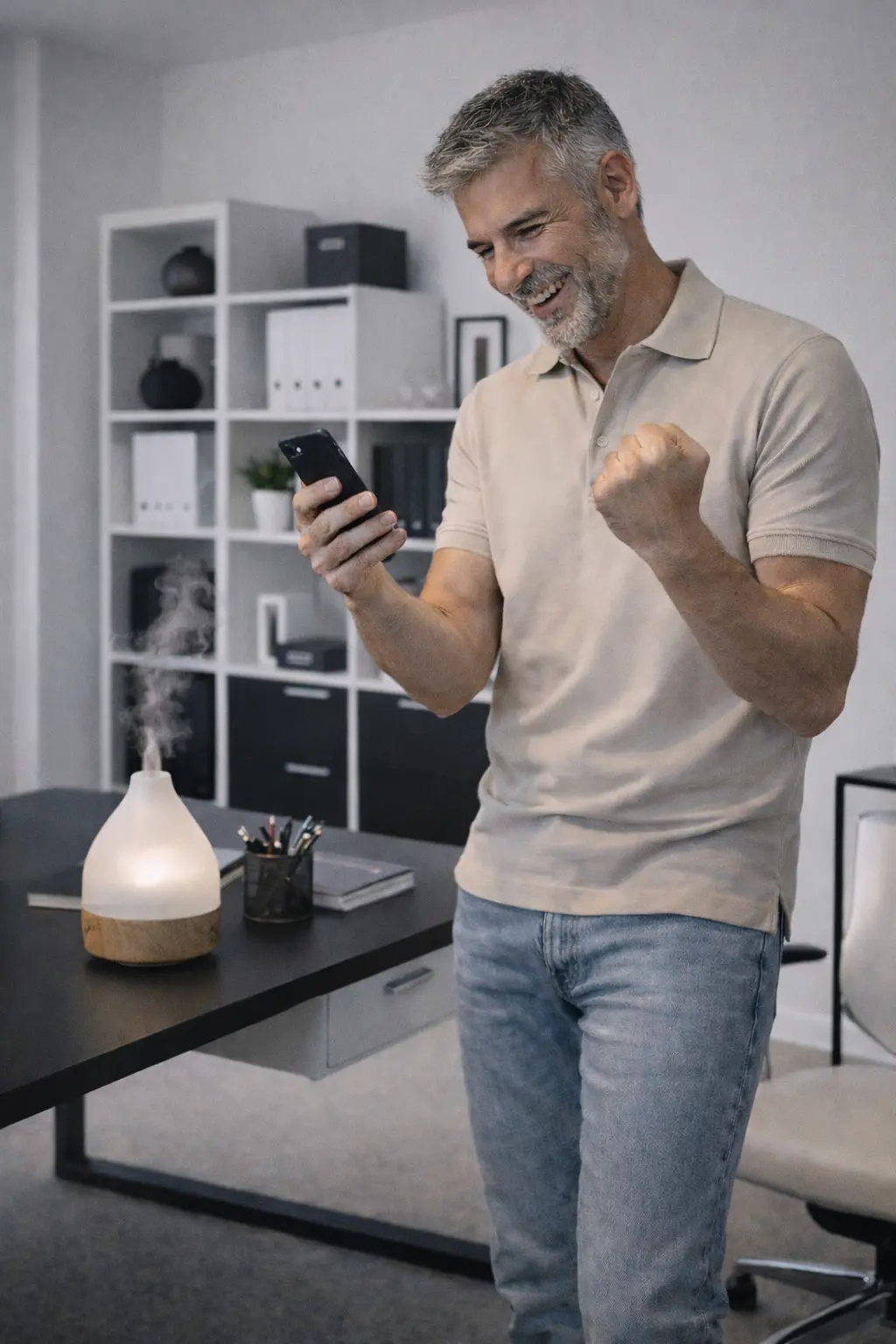
After he hit send, he walked to Ilias and, for the first time in weeks, added a single drop of ylang-ylang to the blend. The floral note rose shyly through the familiar citrus and wood, like a tentative hand reaching out in the dark.
Ilias
I feel something loosen in him - like plaster finally cracking where the wall needed to breathe. For the first time in many nights, he diffuses for more than clarity; he diffuses for courage. Humans underestimate how much bravery smells like a new note in an old blend.
Mica
Her oils tonight are a confession: bergamot to face what she fears, lavender to forgive herself for hesitating, ylang-ylang to admit she still wants more than safety. She has decided — not that he is innocent or guilty, but that avoiding the truth hurts more than whatever the truth might be. My mist curls with something dangerously close to joy.