The Kama Sutra, widely misunderstood in the modern Western context as merely a manual of sexual positions, is in fact a far more sophisticated and holistic treatise on pleasure, intimacy, and the art of living well. Written between the 2nd and 3rd centuries BCE by the Sanskrit scholar Vātsyāyana, this ancient Indian text encompasses beauty rituals, seduction techniques, self-care practices, and a philosophy that celebrates sensuality as a legitimate human endeavor worthy of careful study and refinement. Central to this philosophy is an element that remains as relevant today as it was over two millennia ago: the strategic and sensuous use of aromas and scents. The Kama Sutra's emphasis on fragrance represents a profound understanding of how aromas engage the human senses, elevate emotional states, and create the ideal atmosphere for intimacy and connection.
Understanding the Philosophical Framework
Before delving into the specific aromas and their applications, it is essential to understand the philosophical context in which the Kama Sutra positions sensory pleasure. Unlike cultures that viewed physical desire as something to be suppressed or controlled, ancient Indian philosophy integrated kama - desire and sensual pleasure - as one of the four cardinal goals of human life, alongside dharma (duty), artha (wealth), and moksha (liberation). This perspective fundamentally reframes the pursuit of pleasure not as indulgence or excess, but as a legitimate domain of human development requiring knowledge, skill, and mindfulness.
The Kama Sutra's definitive conclusion was that sexual joy is chiefly derived from the feelings and emotions of intimate togetherness, from the magic and poetry that partners create for each other, rather than from physical acts alone. This insight places aromas in their proper philosophical context: they are not merely decorative additions to intimate encounters, but essential tools for creating the emotional and psychological atmosphere necessary for deep, satisfying connection. The text explicitly acknowledges that in the absence of certain natural virtues - good looks, youth, and other qualities - one can initiate charisma and attraction through artificial means and art. Fragrance, in this context, becomes an art form, a deliberate practice through which individuals enhance their desirability and create an environment conducive to mutual pleasure and spiritual connection.
The Science of Scent and Sensory Response
The ancient practitioners of fragrance understood intuitively what modern neuroscience has confirmed: the olfactory system - the sense of smell - has a direct pathway to the brain, bypassing the rational mind to engage the emotional centers. When scent molecules are inhaled, they travel directly from the olfactory nerves to the amygdala, the brain's emotional center, influencing mood, memory, and desire in ways that are immediate and powerful. This is why a particular fragrance can instantly evoke emotion, trigger memories, or heighten arousal.
In the Ayurvedic tradition, which runs parallel to and informs the philosophy of the Kama Sutra, the sense of smell is known as "Gandha" and is revered for its ability to influence emotions, balance the body's energies (doshas), and promote overall well-being. Ayurvedic practitioners recognized that different aromas have specific effects on the body and mind - some warm and stimulating, others cooling and calming. This pharmacological understanding of fragrance allowed the architects of the Kama Sutra to prescribe specific scents for specific purposes, creating a sophisticated system of sensory enhancement that was both art and applied science.

Sacred Aromas: The Master Scents of Desire
The Kama Sutra and related ancient Indian texts reference a distinct constellation of fragrances that became synonymous with intimacy, attraction, and seduction. These were not chosen randomly; each carried symbolic, physiological, and psychological significance.
Sandalwood (Chandan): Perhaps the most foundational fragrance in the entire Indian aromatic tradition, sandalwood appears throughout the Kama Sutra and related texts as the backbone of intimate seduction. This creamy, woody aroma is both grounding and deeply calming. The wood itself was so prized that temples and palaces were constructed from it for its aromatic and spiritual qualities. In the context of intimacy, sandalwood's warm, smooth scent creates a perfect atmosphere for closeness - fostering a sense of calm intimacy and grounded depth. When applied to the body, its fragrance lingers close to the skin, creating an intimate, personalized aura. The cooling properties of sandalwood also make it particularly suited to summer months or passionate encounters, as it prevents the body from becoming overheated. In the poetic works of Kalidasa, one of India's greatest classical poets, the spring breeze flowing through southern India is described as "gandhavaha" - the scent-bearer - because it carries the essence of sandalwood from distant forests, creating an evocative backdrop for lovers' encounters.
Musk: Regarded as one of the most prized aromatics in ancient India, musk embodies sensuality in its most concentrated form. Described in the Kama Sutra as a warm, body-like aroma that activates desire through its natural animalic undertones, musk was the fragrance of choice for queens, courtesans, and women who wished their presence to linger long after they left a space. This is not accidental: musk contains indolic compounds similar to those found in human sexual pheromones, creating an olfactory connection to primal attraction. The warmth of musk makes it an ideal fragrance to be applied to areas of the body that generate heat - the inner thighs, the stomach, between the breasts - where it would gradually diffuse throughout an intimate encounter. Ancient texts describe how, as lovers' bodies grew warm with passion, the musk would deepen and become increasingly intimate, creating a fragrance experience that evolved with the encounter itself.
Jasmine: Perhaps the most universally celebrated of the Kama Sutra's intimate fragrances, jasmine carries centuries of erotic association. This tropical floral fragrance has been shown in modern studies to increase libido, and ancient cultures recognized its power long before scientific validation. Jasmine contains indole - a compound found in human genitals - which creates an innate olfactory connection to sexuality. Beyond its physiological effects, jasmine produces feelings of euphoria and confidence, making it ideal for preparation rituals before intimate encounters. The sweetness of jasmine is never cloying; it remains sophisticated and seductive, lending itself to combination with deeper, more grounding fragrances. In ancient Indian beauty rituals, women would massage jasmine oil into their hair before braiding it, ensuring that each movement of the head, each tilt of the neck, would release a fresh wave of floral fragrance.
Saffron: This golden spice, among the most luxurious and expensive fragrance ingredients known to the ancient world, was associated with seduction, beauty, and royalty. The Kama Sutra describes saffron-infused oils as ideal for heightening intimacy and deepening emotional connection between lovers. In Ayurvedic practice, saffron is believed to heat the body from within, enhancing vitality and sexual energy. When infused into oils or bathing water, it imparts a subtle, lingering scent that symbolizes both luxury and sensual pleasure. The warm, spicy-floral aroma is linked to intimacy and opulence, and saffron traditionally blends beautifully with jasmine and sandalwood, creating harmonious perfumes used throughout ancient Indian beauty and seduction rituals.
Amber: Warm and woody, the scent of amber creeps subtly across the skin as body heat rises during intimate moments. Not actually essential oil but a fragrance accord crafted from natural ingredients such as labdanum, benzoin, vanilla, and sweet balsamic resins, amber produces a rich, resinous aroma with soft, powdery edges and subtle hints of warmth. In ancient India, amber was burned in bedroom incenses, and its aroma was believed to enhance intimacy by increasing blood circulation and revitalizing hormones. The scent is sultry and seductive without being overpowering, making it an ideal base note that allows other fragrances to shine while adding depth and sensuality.
Rose: Throughout history and across cultures, rose has been the flower of love, and the Kama Sutra acknowledges this powerful association. The sweet, floral aroma of the rose is associated with balancing the heart chakra in Ayurvedic tradition, promoting love, compassion, and emotional equilibrium. Rose petals were floated in bathing water, and rose oil was massaged into skin. The scent creates a romantic atmosphere while grounding the experience in beauty and grace.
Cloves and Cardamom: These spices appear repeatedly in intimate contexts within the Kama Sutra and related texts. When added to betel nuts - which lovers would exchange as tokens of intimacy - cloves and cardamom create a warming, slightly spicy aroma that stimulates the senses and enhances blood flow. As mentioned in the Brihatsamita, these spices can further incite lovers when combined with betel nuts. The intensity of their aroma cuts through, capturing attention and heightening sensory awareness.
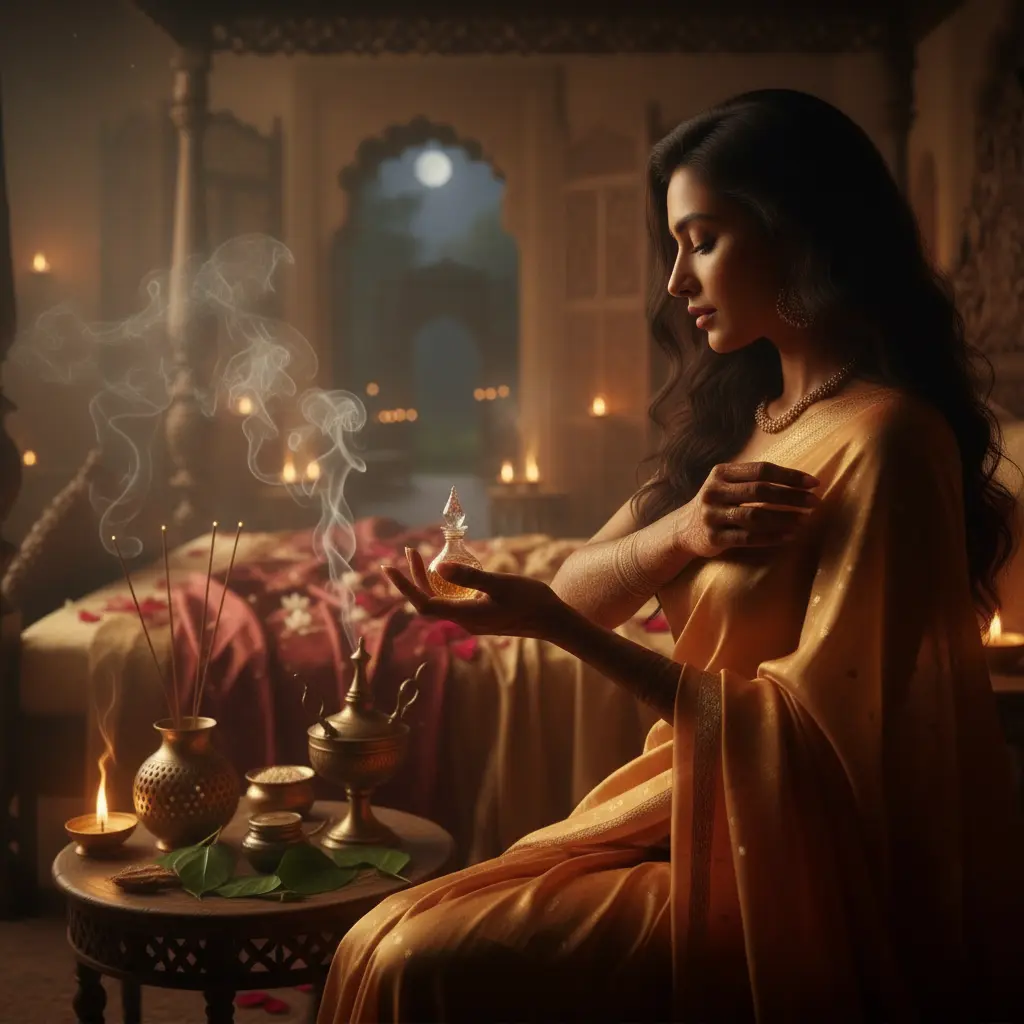
Aroma Diffusion in the Intimate Environment
The Kama Sutra and related texts provide remarkably specific guidance on how to prepare and perfume the intimate space. The textbook approach involves a multi-sensory, layered strategy that transforms a simple room into a sanctuary of sensuality.
Incense and Smoke: The burning of incense (dhupa) was an integral part of preparing the bedroom for intimate encounters. The Kama Sutra's successor text, the Nagrasarvasa, written between 800 and 1300 CE, dedicates an entire chapter to the preparation of perfumes for intimate purposes, as they "fire sexual desires in individuals." Incense burning serves multiple functions: it creates a fragrant atmosphere that permeates the space, it generates smoke that carries aromas upward and outward, and the act of burning itself - with its association with the element of fire and transformation - creates a ritualistic dimension. In the Mughal era, bedrooms were filled with incense made from amber and aloeswood, creating an immersive fragrant environment.
The Indian incense tradition is ancient and sophisticated. Archaeological evidence reveals that incense burners and distillation apparatus made of terracotta date back to 3000 BCE, indicating that the technology and practice of aroma diffusion have been refined over thousands of years. Different forms of incense - sticks (agarbatti), cones, coils, and powders - each offered distinct burning properties and scent dispersal patterns. Incense sticks, the most familiar form, consist of a bamboo core coated with a mixture of natural ingredients such as herbs, flowers, and resins, emitting a delicate, continuous stream of smoke and fragrance. Incense cones, owing to their shape, allow for a uniform burn and release a richer, more potent aroma, creating a more intense fragrance experience suited to smaller intimate spaces.
Oil Application and Body Scenting: Beyond environmental fragrance, the Kama Sutra places profound emphasis on the preparation of the body itself as a fragrant object of desire. This represents a sophisticated understanding of how intimacy engages not only the mind but the entire sensory apparatus of both partners.
According to the text, after bathing and basic grooming, a person - particularly a woman preparing for an intimate encounter - would apply fragrant oils to strategic areas of the body: the breasts, stomach, arms, and inner thighs. These regions generate heat naturally, either through blood flow or through the friction of close contact, which serves as an ideal mechanism for gradually diffusing fragrance throughout an intimate encounter. The heat-activated diffusion meant that as lovers' bodies warmed with passion and movement, the fragrance would deepen and evolve, becoming increasingly intimate and personalized.
The application of oils is treated not as a surface application but as a practice of allowing fragrance to melt into the skin. This differs fundamentally from modern perfume application, which often sits atop the skin. The ancient practice suggests using carrier oils - coconut, almond, or jojoba - infused with essential oils and aromatic plant materials. Such oil-based applications allow the fragrance to become part of the body's own scent ecosystem, creating an aura that is uniquely personal and responsive to body chemistry.
Hair Fragrancing: The Kama Sutra attributes special significance to a woman's hair as a powerful tool of attraction, particularly when enhanced by fragrance. Before combing or braiding, women would massage their hair with fragrant oils of jasmine, musk, or saffron, nourishing the hair while emitting a soft aroma that accompanied every movement. Hair, being porous and volatile, acts as an excellent medium for sustained fragrance release. A turn of the head, a tilt of the neck, or the sway of braids would release a lasting fragrance, creating a moving aura of sensuality that preceded and enveloped the woman's presence.
Bathing Rituals: The Kama Sutra treats bathing not as mere hygiene but as a sensual, ritualistic preparation for intimacy. Women would bathe in saffron water to soften skin, boost radiance, and leave a subtle lingering fragrance. Sandalwood pastes, applied to the body after bathing, cooled the skin (important in a tropical climate where overheating could diminish pleasure), calmed the mind, and surrounded the skin in warm, creamy aromatic notes. Rose, jasmine, and lotus petals would float in bathing water, releasing gentle aromatics that enveloped the body even before oils were applied. These bathing rituals, essential to ancient Indian beauty traditions, primed the skin for the aphrodisiac oils that followed, creating layers of fragrance that would unfold throughout an intimate encounter.
The Philosophical Underpinnings of Aromatic Seduction
It is important to understand that the Kama Sutra's approach to fragrance is not merely about generating sexual arousal, though that is certainly one function. Rather, it reflects a deeper philosophical understanding of how humans create meaning, connection, and intimacy through the engagement of all their senses.
The practice of fragrancing oneself and one's environment represents an act of intentionality and respect toward one's partner. When a woman takes the time to bathe in saffron water, to massage oils into her hair, to anoint her body with carefully selected fragrances - she is not merely preparing herself to be desired; she is preparing herself to be fully present, fully sensual, and fully engaged in the encounter ahead. The preparation itself becomes a form of meditation, a turning inward, a gathering of one's sensual energy. Similarly, when a couple intentionally fills their intimate space with incense, they are creating a boundary between the ordinary world and the realm of desire, marking the space as sacred, as set apart, as worthy of attention and reverence.
The poet Jayadeva, in his classical work the Geeta Govinda, demonstrates this sophisticated understanding of fragrance's symbolic power. He uses scent not merely to celebrate the joy of lovers' union but to convey the pain of separation and longing. When Radha is abandoned by Krishna, the breeze carrying whispers of sandalwood, which had once seemed divine, now feels poisonous, triggering anguish rather than pleasure. This poetic insight reveals a truth that the Kama Sutra understands implicitly: fragrance is not a neutral sensory input but a meaning-making medium through which we encode our emotional and relational realities.

Practical Application: Creating the Fragrant Environment Today
The principles of the Kama Sutra remain applicable to modern intimate life, even though our lifestyles, climates, and access to fragrant materials differ from those of ancient India.
For those wishing to create an intimate space informed by Kama Sutra principles, the layered approach remains most effective. Begin with environmental fragrance - light incense, either traditional Indian agarbatti or a high-quality diffuser oil with sandalwood, jasmine, or amber notes. The goal is to create a subtle fragrance that enhances rather than overwhelms. The space should smell inviting to both partners; overly strong or cloying scents can have the opposite of the intended effect, triggering aversion rather than desire.
Follow this with personal fragrance application. A simple approach involves selecting a carrier oil (jojoba or fractionated coconut oil work well) and infusing it with 2-3 drops of essential oils in complementary scents. Jasmine combined with sandalwood, or amber combined with a hint of clove, creates sophisticated blends. Apply these oils lightly to pulse points - the inner wrists, the neck, the inner elbows, and the inner thighs - allowing body heat to gradually release the fragrance. The intention here is not to announce one's presence through scent but to create an intimate aroma that unfolds during close contact.
Hair fragrancing can be as simple as adding a drop of essential oil to the final rinse water during shampooing, or using a light oil-based hair serum before styling. The goal is subtle, not strong - the fragrance should be discovered, not announced.
The bathing ritual deserves special attention. Rather than viewing a shower or bath as purely functional, approach it as preparation for pleasure. This might involve adding a few petals of rose or lavender to the bathing water, or applying a sandalwood paste to the skin after bathing, allowing it to dry slightly so that the fragrance mingles with the skin's natural oils. The act of bathing becomes a form of self-care and self-honoring, setting a sensual tone for what follows.
Aromas and the Doshas: Personalizing Fragrance
The Ayurvedic principle of the doshas - the three fundamental energetic constitutions (Vata, Pitta, and Kapha) - offers a useful framework for selecting fragrances suited to one's individual nature and current state.
For those with a Vata constitution or currently experiencing Vata imbalance (characterized by lightness, dryness, and variable energy), grounding, warming fragrances are ideal. Sandalwood, amber, and slightly spicy notes like ginger help anchor and stabilize Vata energy. These fragrances create a sense of safety and presence that supports deeper relaxation and intimacy.
Pitta constitutions (characterized by heat, intensity, and strong digestion) benefit from cooling, calming fragrances that prevent overheating and intensity from becoming overwhelming. Rose, lavender, and jasmine - all traditionally cooling in Ayurveda - help balance Pitta and support emotional openness. The cooling properties of these fragrances create an atmosphere of softness and receptivity.
Kapha constitutions (characterized by heaviness, stability, and tendency toward lethargy) require more stimulating, uplifting fragrances that energize and invigorate. Ginger, citrus notes, and the sharper aspects of clove and cardamom help activate Kapha energy and promote circulation and enthusiasm. These fragrances create a sense of vitality and engagement.
Understanding one's doshic constitution allows for more personalized and effective fragrance selection, ensuring that the aromas chosen actually support one's well-being and state of presence rather than working against one's natural tendencies.

The Modern Misunderstanding and the Path Forward
In contemporary culture, fragrance is often treated as a superficial cosmetic concern - a product to purchase and apply rather than a practice to cultivate. The Kama Sutra's approach suggests something far more profound: that fragrance is a language of desire, a medium through which we honor ourselves and our partners, and a tool for creating sacred, sensual space in an increasingly harried world.
The ancient Indian understanding also differs from the modern Western marketing of "aphrodisiacs," which often promises instant, chemical arousal. The Kama Sutra's approach is more subtle, more respectful, and ultimately more profound. Fragrance, in this context, does not create desire where none exists; rather, it supports, enhances, and honors desire that is already present. It creates an environment - physical and psychological - in which genuine connection can flourish.
The text's emphasis on reciprocity, mutual pleasure, and the engagement of all the senses represents a model of intimacy fundamentally at odds with quick, transactional approaches to sexuality. When partners intentionally create a fragrant environment together, when they spend time preparing their bodies with care and attention, when they approach intimacy as an art form worthy of study and refinement - they are honoring a philosophy of human connection that transcends time and culture.
Conclusion: The Enduring Wisdom of Fragrant Desire
The Kama Sutra's treatment of aromas and scents reveals a civilization that understood something fundamental about human sensory experience: that we do not think our way into intimacy; we sense our way into it. The careful selection and application of fragrance - from the incense that fills the room to the oils applied to the skin - represents an elaborate system for engaging the most direct pathway to emotion, memory, and desire: the olfactory system.
Nearly two millennia after Vātsyāyana wrote the Kama Sutra, the fragrances he recommended - sandalwood, jasmine, musk, saffron, amber, rose - remain powerful and relevant. The technologies have changed; the bamboo incense stick is now complemented by diffusers and sprays. But the underlying principle remains constant: that fragrance is a language of love, that the creation of beauty and sensual pleasure is a worthy human endeavor, and that intimacy flourishes when all the senses are engaged with intention, mindfulness, and respect.
In rediscovering the Kama Sutra's aromatic wisdom, we are not indulging in exotic or esoteric practices. Rather, we are recovering an understanding of human pleasure that views the body not as something to be subdued or ignored, but as a sophisticated instrument through which we experience meaning, connection, and joy. The fragrant journey toward intimacy is, in the end, a journey toward ourselves and toward fuller humanity.