Introduction: Unraveling the Mystery of February 14
Every February 14, millions of people worldwide participate in an ancient ritual of expressing love and affection. Roses are exchanged, cards are sent, and couples celebrate their relationships on a day dedicated to love itself. Yet few pause to consider how this tradition began, who its namesake truly was, or why we observe it on this particular date. The story of Valentine's Day is a fascinating tapestry of martyrdom, medieval romance, Victorian commercialism, and the enduring human desire to express emotions we often struggle to verbalize. To understand how a third-century Christian priest transformed into the patron saint of lovers—and how scents and aromas became intertwined with romantic expression—we must travel back nearly 2,000 years.
Who Was Saint Valentine? The Man Behind the Myth
The history of Valentine's Day cannot be told without first addressing a fundamental question: who exactly was Saint Valentine? The answer is more complex than most realize, as historical records and ecclesiastical traditions point to at least two different individuals, both martyred around the same date, with similar narratives that have blended together over the centuries.
Saint Valentine of Rome: The Secret Wedding Priest
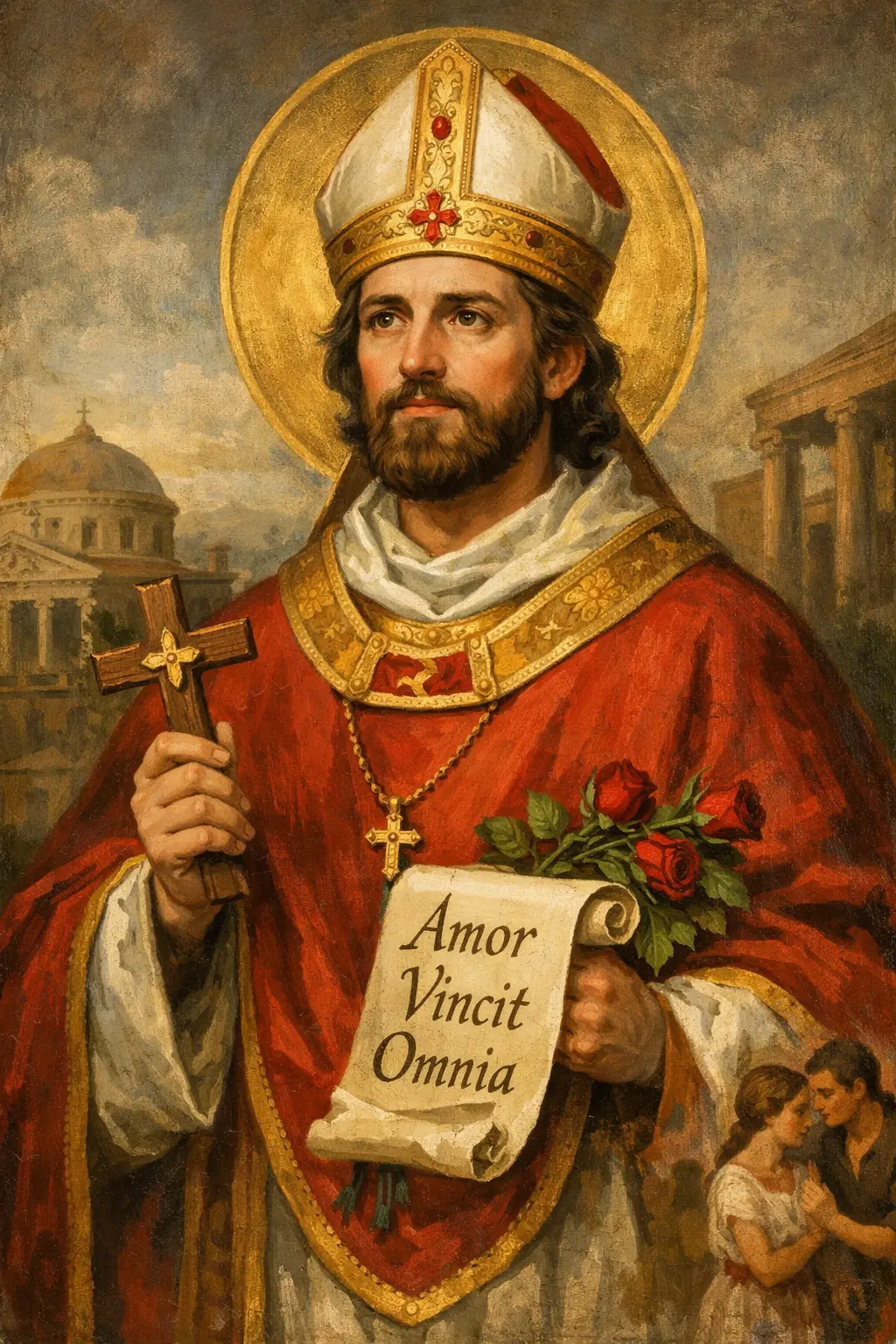
The most widely recognized version identifies Valentine as a Roman priest and physician who lived during the third century, around 270 AD, under the reign of Emperor Claudius II Gothicus. This era represented a particularly brutal period of Christian persecution in Rome. According to historical accounts, Valentine was renowned for his sanctity and miraculous healing abilities, which attracted the attention of the Emperor himself.
Emperor Claudius II had enacted a controversial law forbidding marriage for young men, believing that single soldiers were more effective warriors and less distracted by familial obligations. The edict created tremendous suffering among the Roman population, separating lovers and preventing the sacred bonds of matrimony. Recognizing the injustice of this decree, Valentine defied imperial authority and secretly performed marriage ceremonies for young Christian couples who wished to be united.
One particularly famous account involves a blind girl—the daughter of a Roman nobleman named Asterius. Through prayer and spiritual intervention, Valentine reportedly restored her sight, leading Asterius and his entire household to convert to Christianity. This miraculous healing, combined with his clandestine marriage ceremonies, eventually brought Valentine's activities to the Emperor's attention.
When Claudius II discovered Valentine's defiance, the priest was arrested and imprisoned. Tradition holds that before his execution, Valentine performed one final act of romantic defiance: he wrote a farewell note to his jailer's daughter, signing it with words that would echo through the centuries—"From Your Valentine." On February 14, Valentine was led to the Via Flaminia, Rome's ancient highway, where he was executed by beheading.
Saint Valentine of Terni: The Bishop and Healer
A second tradition preserves the account of Valentine, Bishop of Terni (also known as Interamna), who may have lived approximately seventy years after the Roman priest's martyrdom, around 346-347 AD. Like his namesake predecessor, this Valentine was known for performing miraculous healings that led to mass conversions to Christianity.
According to Church records, a prominent rhetorician and philosopher named Crato brought his severely deformed son, Chaeremon, to Valentine for healing. The boy's condition was so severe that he was forced to hold his head between his knees. When Crato offered Valentine half his possessions in exchange for a cure, the bishop refused payment, instead explaining that faith in God—not worldly wealth—held the power to heal. Valentine prayed, and Chaeremon was restored to health. Moved by this miracle, Crato, his family, and several Greek students embraced Christianity and were baptized.

Notably, the son of the Roman Prefect, Abbondius, also converted through Valentine's ministry. This conversion angered Placidus, the Prefect of Rome, whose parental authority was undermined by his son's religious choice. In retaliation, Placidus had Valentine arrested and executed—again by beheading on the Via Flaminia.
One Saint or Two? The Historical Consensus
Scholars debate whether these represent two distinct individuals or different versions of the same original account. The similarities are striking: both Valentines were clergy devoted to Christian conversion, both performed miraculous healings that sparked conversions, both were martyred by beheading on the same Roman road, and both died around the same calendar date. The Catholic Church recognizes both in liturgical tradition, commemorating the Roman priest and physician on February 14 in Western Christianity, while the Eastern Orthodox Church observes Saint Hieromartyr Valentine, Bishop of Interamna, on July 30.
What remains certain is that by the Middle Ages, these accounts had merged into a powerful narrative: a saintly figure who defied temporal authority in defense of love and marriage, ultimately giving his life for his convictions.
The Path to February 14: From Lupercalia to Christian Feast
To understand why Valentine's Day falls on February 14, we must examine the religious and cultural calendar of ancient Rome—a transition that reflects the broader Christianization of pagan traditions.
Lupercalia: The Ancient Roman Festival of Fertility
Long before Christianity established February 14 as a sacred feast day, ancient Rome observed Lupercalia, a pastoral festival dedicated to fertility and purification. Celebrated annually on February 15, Lupercalia was one of Rome's most significant religious observances. The festival's name likely derived from the Latin word lupus (wolf), connecting it to the legendary she-wolf who nursed Romulus and Remus, the mythical founders of Rome.
The festival was supervised by a corporation of priests called the Luperci, who conducted rituals designed to promote fertility and ensure the health of the community. The most dramatic ritual involved animal sacrifice—priests would slaughter goats and dogs, fashioning strips of skin called thongs from their hides. These ceremonial objects were then used in a shocking practice: the Luperci would run through the city streets, striking people—especially women—with the animal-skin thongs. Paradoxically, recipients eagerly sought these blows, believing they promoted fertility and ensured successful childbirth.
Another element of Lupercalia involved matchmaking. Young women would write their names on pieces of paper, which young men would then draw from a box. These pairings often resulted in marriages, making Lupercalia as much a celebration of love and partnership as it was a fertility rite.
The Christianization of February: Pope Gelasius I and the Transition
As Christianity spread throughout the Roman Empire, Church leaders sought to eliminate—or at least reinterpret—pagan festivals that conflicted with Christian theology and practice. In 494 AD, Pope Gelasius I officially forbade Christian participation in Lupercalia. This decree marked a turning point in the religious calendar.
The precise relationship between the elimination of Lupercalia and the establishment of Saint Valentine's Day on February 14 remains historically contested. Some sources suggest that Pope Gelasius I deliberately replaced the pagan Lupercalia with the Christian Feast of Saint Valentine, a strategic substitution that would redirect the people's celebratory impulses toward a Christian saint while maintaining the February timeframe. Other scholars argue that this connection may be coincidental, noting that Valentine's Day was likely established later, possibly in the eighth century or beyond.
Regardless of the precise historical mechanics, the timing is suggestive: both festivals occupied February, both associated fertility and love, and both eventually converged in popular consciousness. The themes of romantic pairing and sensual celebration that characterized Lupercalia found new expression in the devotion to Saint Valentine, the Christian martyr who had sacrificed his life defending marriage and love against state oppression.
The Medieval Transformation: Chaucer and the Birth of Romantic Valentine's Day
While Saint Valentine was venerated as a Christian martyr since at least the eighth century, his association with romance and courtly love is a distinctly medieval invention—one remarkably traceable to a specific literary moment in fourteenth-century England.
Chaucer's Revolutionary Connection
Geoffrey Chaucer, the author of the Canterbury Tales and one of medieval England's greatest poets, occupies a pivotal place in Valentine's Day history. Sometime around the 1380s, Chaucer composed "The Parliament of Fowls" (also known as "The Parlement of Foules"), a dream vision poem of approximately 700 lines that would fundamentally reshape the meaning of Saint Valentine's Day.
In this allegorical poem, the narrator falls asleep while reading Cicero's "Dream of Scipio" and enters a vision where Nature convenes a parliament of birds to select their mates. Crucially, Chaucer explicitly places this momentous gathering on Saint Valentine's Day:
"For this was on seynt Valentynes day,
Whan every foul cometh there to chese his make"
Rendered in modern English:
"For this was on Saint Valentine's Day,
When every fowl comes there to choose his mate."
Chaucer repeats this connection four times throughout the poem, emphasizing that birds sing in honor of Saint Valentine and choose their mates on his feast day. The poem concludes with explicit invocation of the saint:
"Saynt Valentyne, that are ful hy on-lofte,
Thus syngen smale foules for thy sake"
"Saint Valentine, that are full lofty on high,
Thus small fowls sing for thy sake."
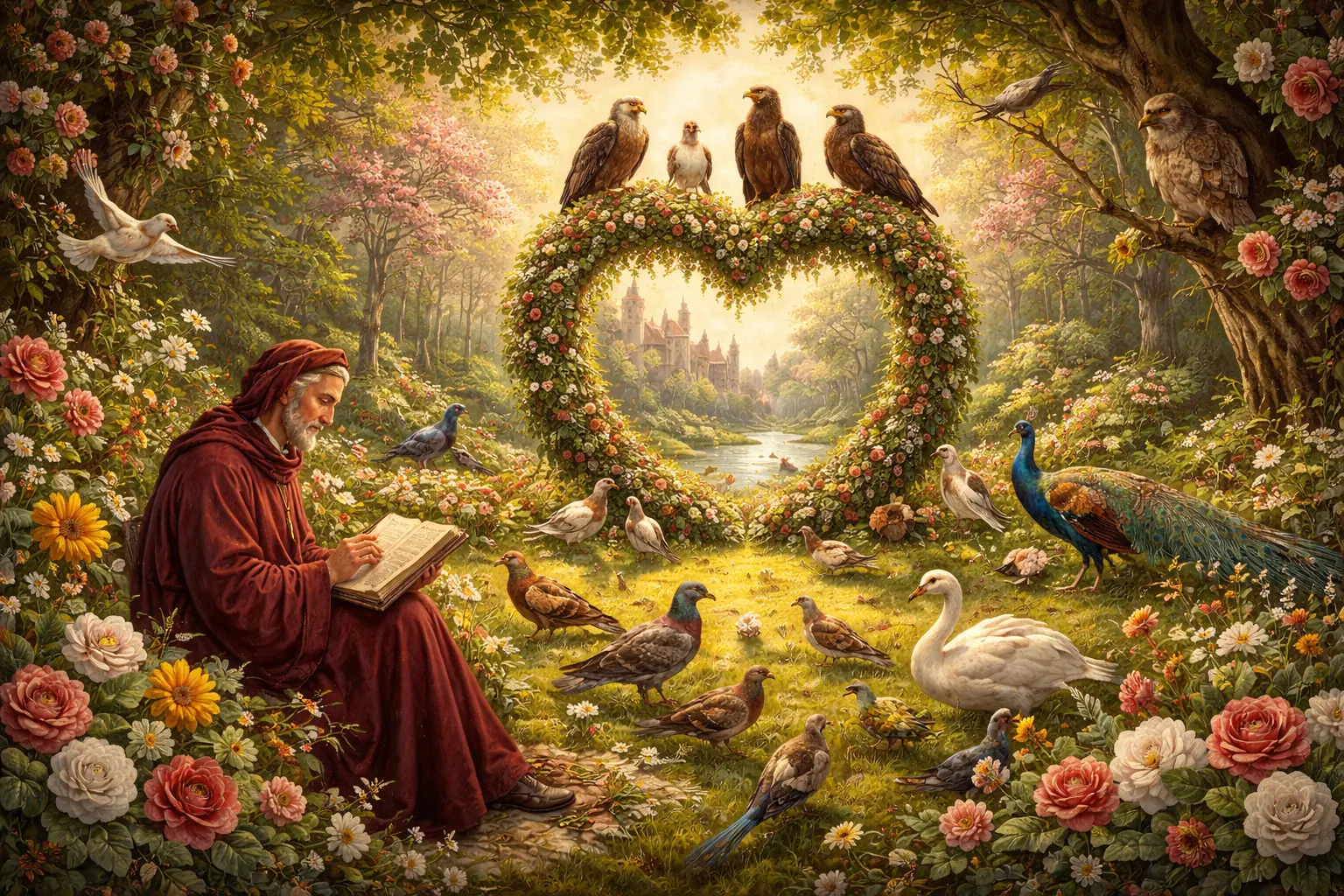
The significance of Chaucer's innovation cannot be overstated. Historical research has found no association between Valentine and romance in literary sources prior to Chaucer. According to medievalist scholar Jack B. Oruch of the University of Kansas, "Oruch's survey of the literature finds no association between Valentine and romance prior to Chaucer. He concludes that Chaucer is likely to be 'the original mythmaker in this instance.'"
The Biological Coincidence That Made It Plausible
Chaucer's poetic invention was made convincing by biological reality. Early to mid-February marks the onset of the bird mating season in the Northern Hemisphere—a natural phenomenon that observers would have recognized as occurring near Saint Valentine's feast day. This convergence of nature's calendar with the saint's feast day provided the perfect foundation for Chaucer's imaginative leap.
The Spread of the Romantic Association
Chaucer's literary innovation did not remain isolated in a fourteenth-century manuscript. Other contemporary and near-contemporary poets embraced the same romantic connection. The English poet John Gower (d. 1408), the French poet Oton de Grandson (d. 1387), and possibly the Valencian poet Pardo all made references linking Valentine's Day to courtly love. These writers, deeply engaged with the medieval tradition of courtly love—an idealized, often secret romantic devotion typically among nobility—found in Valentine's Day a ready-made symbolic framework.
By 1415, just decades after Chaucer's poem, the symbolic association had become sufficiently embedded in cultural memory that Charles, Duke of Orleans, imprisoned in the Tower of London, addressed a poem to his wife calling her "Ma doulce Valentine gent" (my sweet gentle Valentine). The transformation was complete: what had been a religious feast day commemorating a Christian martyr had become, in the space of perhaps fifty years, a day inextricably linked with romantic love.
The Medieval Period: Courtly Love and Romantic Expression
Once Chaucer and his contemporaries established the connection between Saint Valentine and romance, the medieval celebration of February 14 flourished within the context of courtly love—a sophisticated, often idealized system of romantic expression that governed elite society.
Medieval courtly love, particularly in its French and English manifestations, was characterized by elaborate conventions: knights or noble suitors devoted themselves to winning the affection of their lady through displays of military prowess, poetic composition, and devotion. These relationships often existed outside marriage, conducted with carefully coded language and symbolic gestures to avoid scandal while maintaining emotional and spiritual intensity.
Courtly Love and Valentine's Day
Saint Valentine's Day provided the perfect occasion for courtly lovers to express their devotion. The day became a time for handwritten love letters, passionate declarations, and romantic gestures—the precise nature of which often reflected the rigid social hierarchies and gender conventions of medieval society. Medieval lovers expressed their affections through carefully composed verses, the presentation of flowers (particularly roses), and personal items exchanged as tokens of esteem.
The tradition of Valentine's Day cards has roots in this medieval practice. Unlike the mass-produced cards of later centuries, these early valentines were handwritten, carefully composed, and highly personalized—bearing testimony to the depth of feeling they expressed. The act of writing and presenting such a missive was itself a significant gesture, requiring time, literacy, and courage.
The Victorian Era: Commercialization and the Language of Flowers
As industrialization and improved transportation transformed Western society in the nineteenth century, Valentine's Day underwent a dramatic metamorphosis from a medieval romantic practice to a commercialized, mass-produced celebration—though one that maintained its emphasis on expressing intimate emotions.
The Transformation via Postal Reform
A crucial catalyst for this change was the British Postal Reform of 1840. Parliament instituted mail delivery throughout England at an affordable flat rate—the famous penny post—with the innovation of the postage stamp allowing senders to prepay postage. This affordable, reliable mail system revolutionized personal communication. Previously, recipients had to pay the cost of receiving mail, which created perverse incentives: the "Vinegar Valentine" tradition involved sending insulting or heavy (but worthless) packages to disliked individuals, knowing they would bear the postage cost.
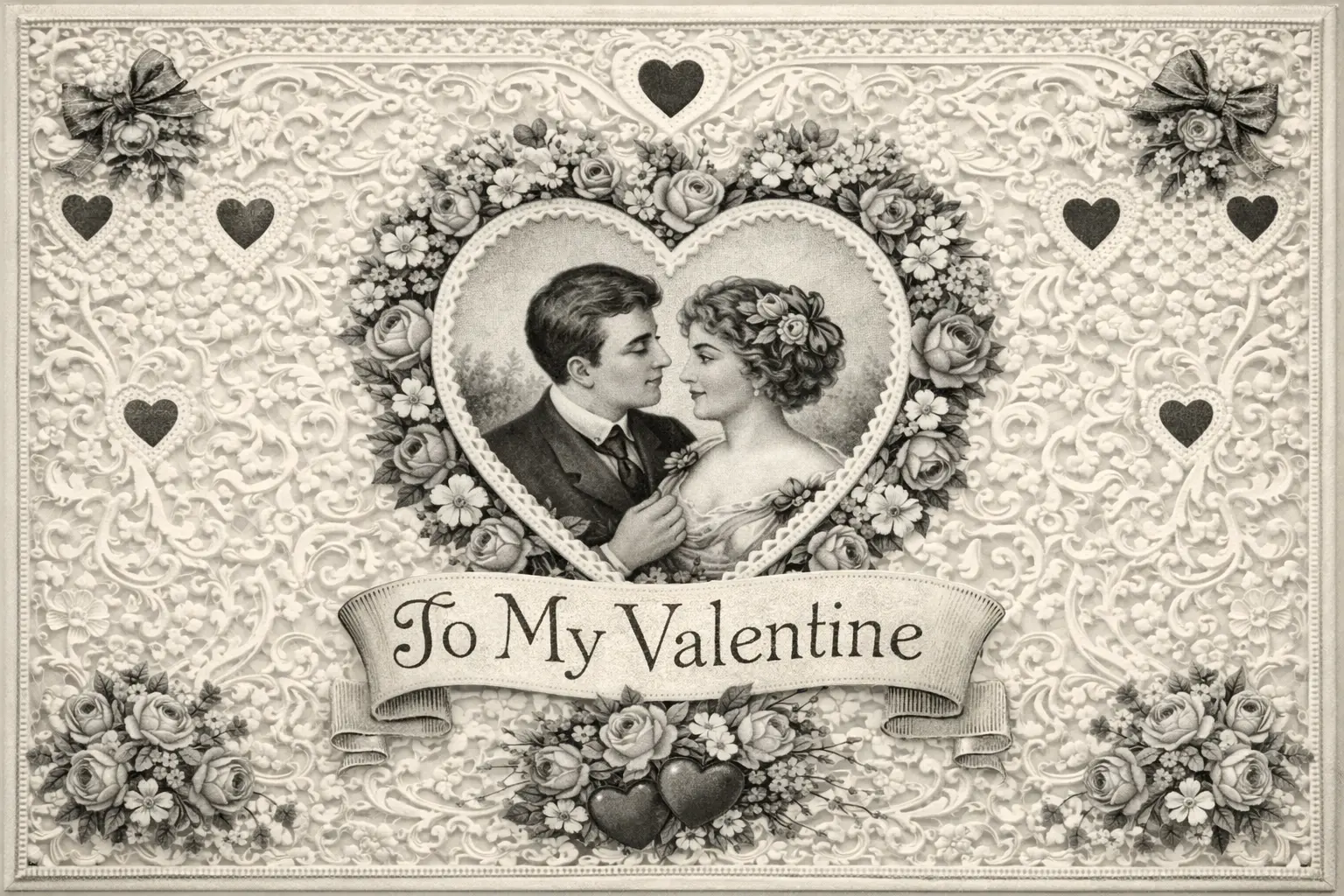
The penny post transformed Valentine's Day sending from a rare, elite practice to a mass phenomenon. The United States subsequently implemented similar postal reforms, creating parallel growth in Valentine's card sending. Suddenly, expressing one's feelings through a mailed valentine became accessible to the middle and working classes—not merely nobility.
Manufacturing Sentiment: The Rise of Commercial Valentine Cards
The democratization of Valentine sending sparked an industrial response. Until the early 19th century, most Valentine's cards were handwritten and handcrafted. By 1850, commercially manufactured cards began to overshadow handmade valentines. By the 1860s, over one million commercially produced Valentine's cards were circulating in London alone.
The manufacturing process itself reflected the industrial age's principles of task specialization and efficiency. Writing in 1866, essayist Andrew Halliday documented the production methods at one of London's leading card manufacturers in his essay "Cupid and Co." He observed approximately sixty workers—predominantly young women, along with men and boys—laboring ten hours daily, year-round, to produce valentines for different market segments and price ranges.
The basic, black-and-white stamped card sold for just one penny. More elaborate versions featured colored lithographed pictures, embossed paper lace, silk, velvet, or even gold leaf—commanding prices of five shillings or more (equivalent to substantial sums in modern currency). The embossing technique, developed in the late eighteenth century, allowed manufacturers to create complex three-dimensional textures by subjecting paper to pressure against dies, producing impressive visual effects.
Esther Howland and the American Valentine Industry
American enterprise transformed Valentine's commercialization into an art form. In 1848, Esther Howland, a young woman in Worcester, Massachusetts, founded a significant valentine manufacturing firm. Seeking to outcompete imported European valentines that dominated the market, Howland used lithographed pictures, embossed paper lace, and assembled components to create impressive cards that sold widely, despite commanding high prices equivalent to more than $100 in modern currency.
Howland's success established her as a pioneering female entrepreneur—a remarkable achievement in the nineteenth century. Her business model of component assembly and quality production became the template for the American valentine industry. By the early twentieth century, postcard valentines inspired by the 1893 World's Columbian Exposition in Chicago sparked an additional fad, with German manufacturers dominating the market through mechanized "pop-up" three-dimensional cards.
The "Vinegar Valentine" Controversy and Manufactured Cruelty
While Victorian culture emphasized sentimental, romantic valentines, a darker subset of the tradition coexisted: so-called "Vinegar Valentines"—insulting cards with grotesque caricatures and rude verses designed to mock or deride recipients. Some targeted specific professions or mocked individuals deemed unfashionable or unattractive. Scholars debate whether these represented light-hearted jests among friends or more genuinely cruel taunts.
The existence of both sentimental and insulting mass-produced cards intrigued observer Andrew Halliday, who found "both fascinating and bizarre" this phenomenon: "the mass production of cards for profit to help people articulate their genuine feelings." Yet it remains a fundamental aspect of Valentine's Day tradition to this day—the commercial manufacture of intimacy and emotion.
The Rose Ascendant: Flowers, Fragrance, and the Language of Love
No exploration of Valentine's Day would be complete without examining the rose—the flower that has become synonymous with romantic expression—and the broader phenomenon of floral symbolism that flourished alongside Valentine's Day commercialization.

Ancient Roots: Aphrodite and the Origin of the Red Rose
The symbolism of the rose reaches far back into antiquity, predating Valentine's Day by centuries. In Greek mythology, the red rose was born from the tears and blood of Aphrodite, the goddess of love, mourning her dying lover Adonis. According to legend, as Aphrodite rushed to Adonis's side after he was mortally wounded, her tears and the drops of blood from her feet (cut by thorns) mingled with his blood, giving birth to the first red roses.
In Roman culture, which inherited and adapted Greek mythology, red roses became associated with Venus (the Roman equivalent of Aphrodite) and were featured prominently in bedrooms and banquet halls, symbolizing secrecy, pleasure, and love. The tradition of secrecy became particularly encoded in the phrase sub rosa (under the rose), signifying matters discussed in confidence and protected by confidentiality.
Medieval and Renaissance Elevation
During medieval Europe, the red rose's symbolic significance deepened. The flower became intimately associated with the Virgin Mary, representing both her perfection and the sacred secrecy of holy love. Within the courtly love tradition, medieval knights and troubadours routinely presented red roses to their ladies as expressions of admiration and undying passion. Poets and artists elevated the rose to supreme status as love's ultimate symbol.
By the Renaissance, artists like Sandro Botticelli consistently featured red roses in their depictions of Venus, further cementing the flower's place in Western romantic and artistic tradition.
The Victorian "Language of Flowers" (Floriography)
The nineteenth century witnessed an explosion of floral symbolism formalized as floriography—the art of communicating feelings through flowers. This phenomenon emerged directly from restrictive Victorian social conventions that severely limited the ways individuals (particularly women) could express emotions, especially romantic feelings.
In an era when direct declarations of romantic attachment were considered inappropriate or even scandalous, particularly for women, the language of flowers provided a covert communication system. Each flower, and indeed each color variety, carried specific meanings. Different numbers of flowers conveyed different sentiments. Even the manner of presentation—upright or inverted—altered the message.
The popularization of this practice is attributed to Lady Mary Wortley Montagu, wife of a British ambassador to Turkey in the early eighteenth century. In 1716, Montagu wrote a series of letters describing the Turkish tradition of assigning meanings to flowers to send secret love letters. In her words: "There is no colour, no flower, no weed, no fruit, herb, pebble, or feather that has not a verse belonging to it: and you may quarrel, reproach, or send letters of passion, friendship, or civility, or even of news, without ever inking your fingers."
When her letters were published in 1763, they sparked widespread European fascination with flower language. During the Victorian era, this practice reached its apex. Red roses came to symbolize passionate love and desire; white or pale roses signified devotion and purity; yellow roses conveyed friendship and joy; and pink roses expressed tender sympathy and gratitude.
The Rose Boom: Cultivation and Commerce
The increasing commercial demand for roses during the Victorian era sparked horticultural innovation. Botanists throughout Victorian England and France worked to develop new rose varieties with enhanced colors, fragrances, and longevity. In the northeastern United States, the American Beauty rose—a cultivar reportedly shipped from New Jersey to Queen Victoria herself—became famous as the "millionaire's rose" due to its expensive price point in the 1800s. This particular variety remains the archetypal Valentine's Day rose today.
The combination of symbolic meaning, horticultural development, and commercial interest transformed the rose from a pleasant flower into an essential component of romantic expression—a status it has maintained to the present day.
Scents of Romance: The Aromatic Dimensions of Love Through History
While visual symbolism in roses dominated popular consciousness regarding Valentine's Day, the aromatic dimensions of love—the role of fragrance and scent in romantic expression—had equally ancient roots but received less explicit cultural codification.
Ancient Aromatics and Feminine Expression
Ancient civilizations extensively utilized fragrant essential oils and plant-based perfumes for beauty, health, and sensual purposes. However, it was during the Victorian era that scent became explicitly encoded into the language of romantic expression, particularly for women.
The same restrictive social conventions that generated the coded language of flowers also made perfume and fragrance into tools of seduction and covert communication. Women could subtly influence potential suitors through carefully chosen floral scents—violet, honeysuckle, rose—that would signal romantic interest without violating social propriety. The act of wearing a particular scent became itself a form of hidden speech, a way of projecting desires that could not be spoken aloud.
The Science of Scent and Emotion
The power of scent to evoke emotion and desire is rooted in neurobiology. The olfactory system is uniquely connected to the limbic system—the brain's emotional and memory center—in ways that other senses are not. A particular fragrance can trigger vivid memories and emotional responses, sometimes with surprising intensity. This neurological foundation explains why scent became such an effective tool for romantic communication.
Moreover, many floral scents possess naturally occurring aphrodisiac properties that literally influence physical and emotional responses. The compounds in rose oil, jasmine, and other romantic florals can stimulate endorphin production, heightening pleasure and emotional receptivity. Whether consciously or unconsciously, Victorian women who selected these fragrances were deploying chemistry as an instrument of romantic intention.
Key Aromatic Components of Victorian Valentine Romance
Several plant-based scents became particularly associated with romantic expression during the Victorian era and continue to be featured in modern Valentine's Day traditions:
Rose: The paramount floral aroma, rose was known as the "queen of aromatherapy" and remains the quintessential fragrance of romance. The production of rose essential oil—requiring approximately 10 kilograms of rose petals per bottle—made rose oil a luxury commodity, reinforcing its association with opulence and romantic devotion.
Jasmine: Designated the "king of flowers," jasmine essential oil offers a supremely sweet, sensual aroma that was believed to inspire confidence and lift mood. It featured prominently in Victorian perfume blends designed to enhance feminine allure.
Lavender: Traditionally placed under the pillows of newlyweds to encourage passion, lavender offered a soothing yet sensual aromatic profile.
Neroli: Derived from orange blossoms, neroli essential oil was used to crown brides in some cultures to calm pre-wedding nerves. Its delicate bitter-sweet floral scent represented the complex emotions of romantic transition.
Ylang Ylang: An exotic oil with versatile applications, ylang ylang pairs beautifully with rose, jasmine, and other floral notes to create deeply romantic aromatic blends.
Modern Essential Oil Renaissance: Aromatherapy and Valentine's Day
In contemporary Valentine's Day celebrations, the aromatic dimension has experienced a remarkable resurgence through the increased popularity of essential oils, diffusers, and aromatherapy practices. Couples and individuals now deliberately incorporate romantic scents into their Valentine's celebrations through:
- Diffusers releasing rose or jasmine essential oils to create romantic ambiance
- Luxurious baths infused with rose oil, neroli, or lavender
- Custom massage oil blends combining rose, sandalwood, patchouli, and ylang ylang
- Scented candles featuring romantic floral compositions
- Personal fragrances worn as perfume or cologne
This modern practice represents, in essence, a return to Victorian sensibility—using fragrance as an instrument of romantic expression—but now grounded explicitly in scientific understanding of olfaction's emotional power. The practice acknowledges that creating a fully romantic experience requires not just visual beauty (roses) and verbal expression (cards) but also the aromatic dimension that speaks directly to the limbic system and triggers genuine emotional response.
Global Evolution: Cultural Variations in Valentine's Day Traditions
While Valentine's Day has achieved remarkable global reach, particularly through Western commercial and cultural expansion, the ways different cultures celebrate reveal fascinating local adaptations and persistent alternative traditions.
Western Europe: The Heartland of Valentine's Tradition
In Western Europe, where Valentine's Day traditions have deepest historical roots, the celebration remains relatively consistent:
France maintains its reputation as the romance capital, with couples exchanging red roses accompanied by handwritten love letters—continuing the medieval courtly tradition of poetic expression. Italy treats red roses as a declaration of passionate, enduring love. Spain and Portugal incorporate Valentine's into broader "Dia del Amor y la Amistad" (Day of Love and Friendship) celebrations, extending gift-giving to friends as well as romantic partners.
The American Expansion and Commercialization
The United States, building on Victorian card-manufacturing traditions, transformed Valentine's Day into a commercialized extravaganza. Approximately 250 million roses are grown annually in the United States for Valentine's Day alone. The American model—featuring elaborate gifts, restaurant reservations, expensive jewelry, and substantial floral arrangements—became the template exported globally through American cultural influence.
Asian Adaptations and Modifications
Japan presents a fascinating variation where men traditionally give gifts (especially red roses) to women on February 14, with women reciprocating one month later on "White Day" (March 14) with their own gifts. This gendered division reflects traditional Japanese courtship customs.
South Korea has extended the tradition further, adding "Black Day" (April 14), when single individuals gather to consume black noodles and ice cream in self-affirming celebration.
India demonstrates the complexity of cultural adoption, with red roses becoming increasingly popular in urban areas despite cultural and religious reservations about public displays of romantic affection in more conservative communities.
Non-Western Traditions and Resistance
Not all cultures have embraced February 14 romanticism uniformly. Russia maintains distinct floral traditions, with odd numbers of flowers reserved for celebratory occasions, even numbers traditionally reserved for funerals. Middle Eastern countries experience complex negotiations between globalized Valentine's Day marketing and local cultural and religious values, with red roses sometimes exchanged privately while public displays remain culturally sensitive.
These variations demonstrate that despite globalization, local history, religion, and cultural values continue to shape how celebrations are understood and practiced. Valentine's Day has become simultaneously universal and culturally specific—a global phenomenon that is interpreted through distinctly local lenses.
Modern Valentine's Day: Integration of Tradition and Innovation
Contemporary Valentine's Day celebrations represent a synthesis of historical elements: medieval courtly love expression, Victorian sentimentality and commercialization, the symbolic language of flowers and scents, and modern innovations in communication and experience design.
Beyond Romantic Couples
Modern celebrations have expanded beyond exclusive romantic partnerships. "Galentine's Day" (February 13) celebrations emphasize platonic sisterhood and female friendship. The LGBTQ+ community increasingly adopts Valentine's Day symbolism to celebrate diverse love stories. Self-love and personal care have become legitimate dimensions of February 14 celebration.
The Permanence and Evolution of Roses and Scents
While traditional red roses remain the dominant Valentine's gift globally, innovation continues. Preserved or eternal roses—treated with special techniques to last for years—appeal to those seeking lasting symbols. Fair-trade and sustainably sourced roses address environmental concerns. Customized arrangements with personal messages gain popularity.
Essential oils and aromatherapy have become mainstream components of Valentine's Day celebration, particularly as consumers increasingly understand the neurobiological connection between scent and emotion. Couples create custom aromatic experiences, and individuals curate sensory environments for self-love practices.
The Commercialization Paradox
Modern Valentine's Day exists in productive tension with its commercialization. While mass-produced cards, factory-grown roses, and commercial restaurants dominate the landscape, the human impulse these represent—to mark a day dedicated to love and connection through meaningful gestures—remains genuine. The commercialization of Valentine's Day does not negate the authenticity of the emotions expressed through it; rather, it provides accessible channels for expressing feelings that humans might otherwise struggle to articulate.

Conclusion: The Eternal Appeal of Valentine's Day
The journey from Saint Valentine—the third-century priest who defied an emperor to celebrate marriages—to modern February 14 celebrations spanning the globe reveals how a holiday can accumulate layers of meaning over centuries. What began as religious commemoration of martyrdom transformed through Chaucer's poetic genius into an association with romantic love. Victorian commercialism made these expressions accessible to millions. The symbolic language of roses and the aromatic power of fragrance provided sensory dimensions to emotional expression. And in our contemporary moment, Valentine's Day continues to evolve, incorporating new traditions, expanding definitions of love, and embracing both ancient practices and modern innovations.
Saint Valentine's sacrifice on behalf of love continues to resonate across nearly two thousand years because it speaks to something fundamental in human experience: the desire to love, to celebrate connection, and to defy forces—whether emperors or modern social constraints—that would limit our capacity for intimacy and commitment. The red rose and the scent of romance are not mere commercial constructs but rather contemporary expressions of an ancient truth: that love matters, that it deserves expression, and that certain moments—marked on a calendar and celebrated communally—help us honor its significance.
Whether through a handwritten letter, a carefully selected fragrance, a single red rose, or a quiet moment of self-reflection, Valentine's Day endures because it answers a deep human need: to pause, to declare our feelings, and to celebrate love in all its forms.